Have you ever found yourself reading verses from the Bible and then wondering what they mean or how they relate to you? I think we’ve been there. God’s word is given to humanity to understand God’s true nature and His plan for mankind.
16 All Scripture is given by inspiration of God, and is profitable for doctrine, for reproof, for correction, for instruction in righteousness, 17 that the man of God may be complete, thoroughly equipped for every good work. (2 Timothy 3:16, 17)
People have a longing to know their Creator, and by studying and reflecting on the Scriptures, we can find answers to many of our questions. However, without a few simple keys to unlock the mysteries of God (Colossians 1:26), the Bible can seem like a collection of unrelated stories or strange events without any overall purpose.
The Old Testament was authored by men who were guided by God’s spirit regarding events before Jesus was born. Similarly, inspired men wrote the New Testament about events that occurred afterward. These texts were originally composed in Hebrew and Greek, lacking the sentence structure we use today, meaning there were no paragraphs, sentences, punctuations or even vowels. Translators have worked hard to turn the original text into a language we can both read and understand. Generally, they succeeded, but there are some errors in interpretation due to their understanding of different church doctrines. Additionally, the choice of specific English words in the translation can lead to meanings that differ from what the original writer intended. So with the introduction of sentence structure, even the addition or placement of a comma can completely alter the meaning. Therefore, to study and gain an understanding of the scriptures, we need to be aware of these potential issues and use study aids.
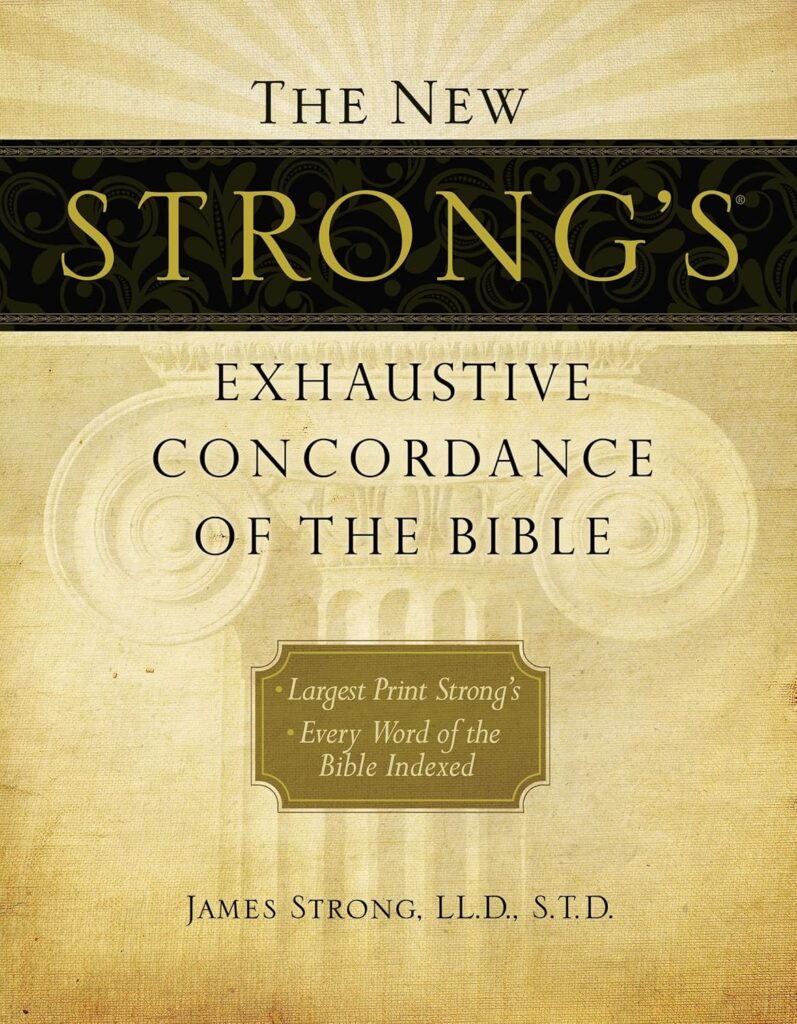
Many books are also available today to help us in our studies. Two great types of resources are a concordance, like Strong’s ExhaustiveConcordance of the Bible
or Young’s Analytical Concordance,
another good one is Cruden’s Complete Concordance
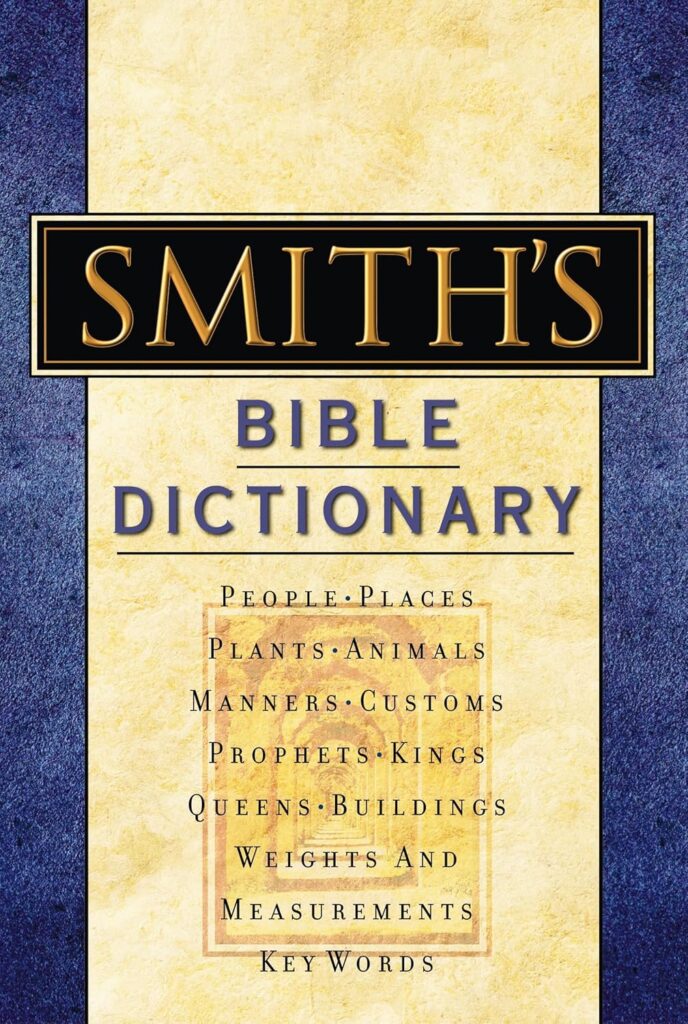
and a reliable Bible dictionary, such as Vine’s or Smith’s.
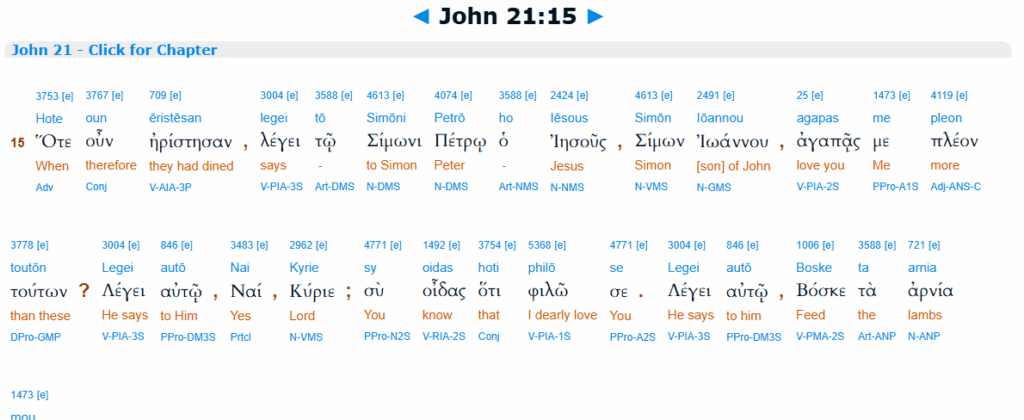
A Good Interlinear is also helpful.
Every book in the Bible was written to reveal and support God’s word from Genesis to Revelation. By using various study methods, anyone can find help in connecting the scriptures throughout the Bible.
Now, let’s look at a topical study method, which is the preferred study method of Bible Students. Pick a topic and look it up. For instance, to grasp God’s love for humanity, a topical study on love should be conducted, which involves searching for all the words related to the word love in the concordance. The same topical study approach can be applied to promises, covenants, laws, ransom, etc.
First, think about the meaning of the word love in John 21:15-17 (KJV);
“So when they had eaten, Jesus said to Simon Peter, Simon, son of Jonas, do you love (agapao) me more than these? He replied, Yes, Lord; you know that I love (phileo) you. He said to him, feed my lambs. {16} He asked him again the second time, Simon, son of Jonas, do you love (agapao) me? He answered, Yes, Lord; you know that I love (phileo) you. He said to him, Feed my sheep. {17} He asked him the third time, Simon, son of Jonas, do you love (phileo) me? Peter was hurt because he asked him the third time, Do you love (phileo) me? He replied, Lord, you know everything; you know that I love (phileo) you. Jesus said to him, Feed my sheep.”
According to Strong’s definition, agapao means to love in a social or moral way (a love of the head). Phileo refers to a love for a friend or having affection for someone (a love of the heart).
Why did Jesus use the word agapao in his question to Peter the first two times and phileo the last time? Why did Peter respond with phileo all three times? Phileo implies an action driven by emotional or heartfelt feelings for family or friends. The love Jesus demonstrated, which mirrors God’s love, included phileo but was a superior form of love rooted in true moral understanding. Agapao represents a love that does not come with a sense of obligation. Jesus instructed Peter to shepherd the sheep (Israel) without needing him to love them first.
Consider John 3:16 (KJV), “For God so loved (agapao) the world, that He gave His only begotten son.” Humanity, having fallen into sin (Romans 5:12, 19), was disobedient and failed to love in accordance with His will. The highest form of love man could attain was phileo love for God. However, Christ’s love was completely obedient. (Romans 13:10) Additional instances of the word agapao can be found in the word love in Matthew 5:43-46. Furthermore, mankind’s love (phileo) was illustrated by the scribes in Luke 20:46.
Let’s look at love as described in Romans 12:9, 10 (KJV): “Let love (agape, derived from the word agapao) be genuine. Detest what is evil; hold fast to what is good. {10} Be devoted to one another in brotherly love (philadelphia, which means fraternal or brotherly affection).
By examining the Greek term and its meaning, we gain a deeper and clearer insight into the concept of love. To genuinely love God, we need cultivate a higher form of love, known as agape love.
I’d like to invite you to request the free booklet, How to Study the Bible and Have It Make Sense. This resource will provide you with additional methods to explore the depth of God’s love. Simply click on the link and download your free pdf copy.